






Our team works with you during every phase of the project.
Contact Us

hotproduct
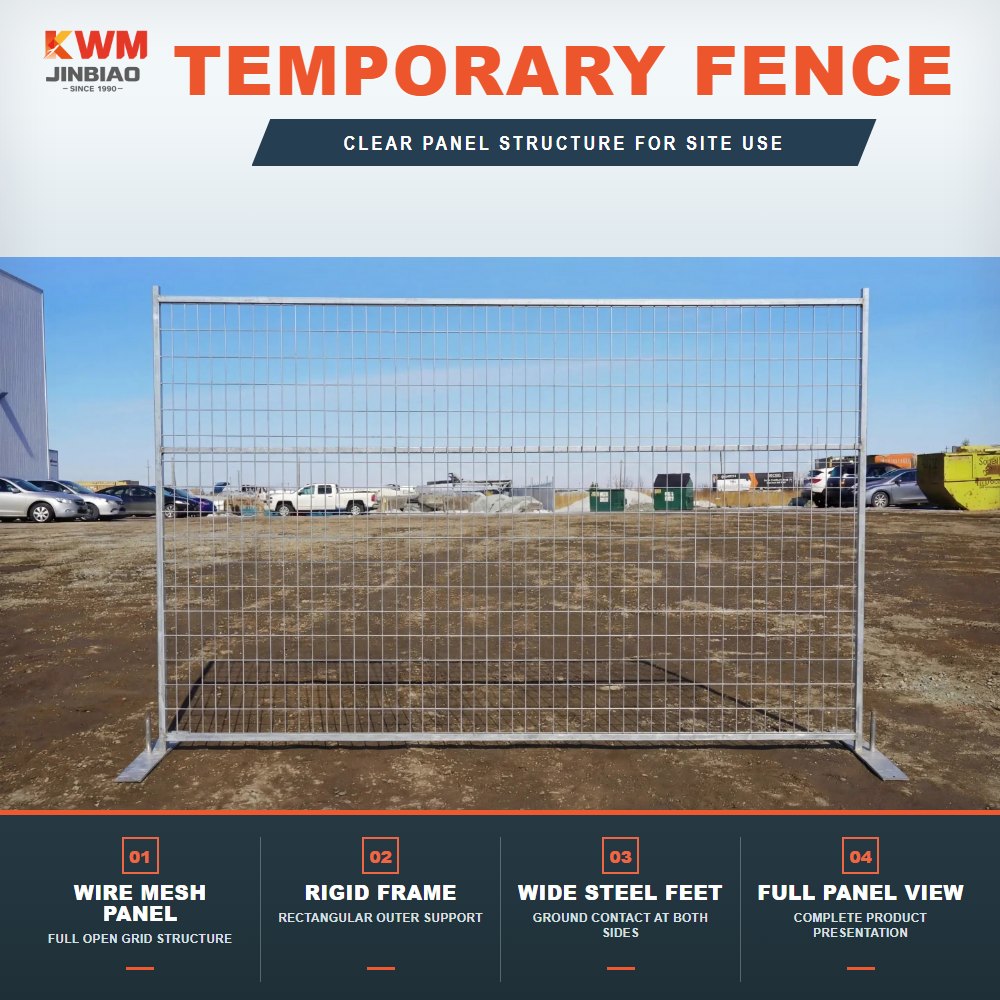
A temporary fence is hired for weeks and judged on two things that never appear on the datasheet: whether it stays upright in wind, and whether it can be moved twice a week without falling apart. Both come down to the feet and the bracing, not the panel.
Four components, and buyers usually over-specify the first and under-specify the rest:
| Component | Typical specification | What goes wrong if it is skimped |
|---|---|---|
| Panel | Welded mesh in a tubular frame, commonly 2.1 m high by 2.4 m or 3.5 m wide; 3.0–4.0 mm wire | Panel racks and the run goes out of line |
| Feet | Blow-moulded plastic or recycled rubber, filled with water or sand on exposed sites | The whole run lifts in gusting wind |
| Couplers | Clamps at top and bottom rail, or purpose-made panel connectors | Panels hinge at joints and the line folds |
| Bracing | Diagonal stays at corners, ends and every change of direction | Long straight runs lean and eventually drop |
On a site where the fence is moved weekly, the couplers and feet take far more abuse than the mesh. That is where the specification should be argued.
A temporary fence is a solid-ish surface on a light base. It does not fail from someone pushing it; it fails in wind, and almost always at the feet or at the coupler.
What we do about it on supply:
Feet are ballasted, not just placed. Water-filled feet are the default; on exposed sites sand or concrete-filled feet are specified, and the fill weight is part of the layout drawing.
Run length between braces is capped. A long straight run without a stay is the most common cause of a collapse.
Panels are set with the mesh face to the prevailing wind where the site allows it, and the run is broken at corners rather than curved.
If the site is coastal, elevated, or has a long open fetch, say so at enquiry stage — it changes the foot specification and sometimes the panel height.
Two sizes do most of the work:
2.1 m high × 2.4 m wide — the standard site panel. Handles most hoarding and compound work and is manageable by two people.
2.1 m high × 3.5 m wide — fewer panels, fewer joints, faster to run. Heavier to handle and needs more bracing at the ends.
Height matters more than width for containment. Going above 2.1 m on a temporary system usually means a different product rather than a taller panel.
Gate openings on temporary fencing fail for one predictable reason: the gate panel is hung on the same feet as the run, and the run takes the load.
Practical requirements we ask for at quote stage: gate width, whether it is pedestrian or vehicle, hinge side, and whether it needs to open against a slope. Vehicle gates on temporary systems need their own ballasted feet and a brace on the hinge side.
The break-even is not a fixed period; it depends on how many times the fence is moved. As a rough guide, a project that keeps the same fence line in place for a long duration is usually cheaper bought, while a project that repositions weekly is usually cheaper hired because the hire price includes the handling damage.
If you are buying, the number that matters is how many cycles the couplers and feet survive, not the panel's first-day appearance.
The sequence matters more than the components. A run laid out in the wrong order ends up with the braces in the wrong place and the gate out of square, and it has to come apart again.
Set the line and the gate openings first. Mark the corner positions and the gate width on the ground before anything is placed. Gates that are positioned last are the ones that end up not closing.
Place feet, then panels. Feet go down on the marked line, filled and settled before panels are lifted in. A foot that is nudged after the panel is on will not sit true again without lifting the panel.
Couple top and bottom at every joint. Two couplings per joint, not one. A single top coupling lets the panels hinge.
Brace at corners, ends, and every run over about fifteen metres. Diagonal stays on the outside of the corner, fixed to a ballasted foot, not to a panel.
Check the line before filling the last feet. A string line down the face will show a stepped or leaning panel while it is still cheap to correct.
On a site where the fence moves regularly, the same sequence applies in reverse for removal, and the panels are stacked in the order they came off. That one habit is the difference between a fence that survives ten moves and one that survives three.
Most temporary fence that fails early was damaged in transit rather than on the line. Three things we see repeatedly:
Panels stacked flat on the ground rather than on bearers — the bottom panel takes the weight and the frame distorts.
Feet thrown into a skip — a cracked foot looks serviceable and then splits on the first windy night.
Couplers lost — a run re-erected with wire ties instead of couplers has no rigidity at the joints.
If the fence is being bought rather than hired, ask how many couplers and feet come with each panel. Under-supplying those two is the standard way to make a quote look cheaper.
Total run length and the number of corners.
Panel height and preferred width.
Site exposure — inland sheltered, open, or coastal.
Number and type of gates.
Whether feet will be water, sand or concrete filled.
Duration and how often the line moves.
Items three and six decide the foot specification, which is where most of the cost difference between two quotes actually sits.
Divide the run length by the panel width, then add one panel for every corner and one at each end gate. Always add roughly five percent for damage and for the odd panel that will not sit true on uneven ground.
Yes, but the feet need a bearing surface. On soft or recently graded ground, feet are set on a timber or paving bearer, or a ballasted foot is used. On a slope, the panels step rather than follow the gradient.
There is no single figure that applies to every layout — the rating depends on run length, bracing spacing, foot ballast and panel height together. That is why we ask for the site exposure and the layout rather than quoting a number in isolation.
Yes. Panels stack flat and are usually moved in stillages or on a flatbed with the feet in separate bins. Tell us the vehicle type if you need a loading plan.
It is used for crowd lines, but the bracing and ballast requirements are stricter than for a closed site, and gate widths are set by the event plan. Send the layout and we will specify to it rather than to the site default.
Send us the run length, the site exposure and the gate schedule and we will come back with a panel and ballast specification plus a price per panel.
For the product range see CA temporary fencing, and for a worked example of a site layout see temporary fencing panels. If you are budgeting a whole site, the construction site fencing guide covers the rest of the package.
Contact Us
Imfornation
Noise Control Solutions6m High Noise BarrierInfrastructure Noise Control5m High Noise Barrier2m High Noise BarrierResidential Noise Barrier: Height, Planning and AppearanceNoise Barrier Guide: Types, Height, Cost and SelectionHospital Noise Barrier: Ward Targets, Height and CleanabilityAnti-Climb Fence Specification: 358 Mesh, Paladin Pales and 3D PanelsSolar Noise Barrier Cost: What Drives the Price and the PaybackRailway and HSR Noise Barriers: Design for Speed and Clearance4 Meter Noise Barrier PanelCooling Tower Noise Barrier: Layout, Airflow and Panel Design1Temporary Fence: Panels, Ballast and Wind Load on Site29 STC Noise Barrier WholesaleGabion Baskets for sale3D-Welded Mesh fencing systemConstruction Site Noise Barriers: Temporary Screens That Move With the Works358 Security Fence: Mesh, Wire and Anti-Climb SpecificationDouble Wire Fence: 868 and 656 Panels, Posts and FixingsAluminum Alloy Noise Barrier SupplierChain Link Fence: Wire, Mesh and Coating SelectionSubstation and Transformer Noise Barriers: Controlling Low-Frequency Hum3D Curved Fence Panel ManufacturersNoise barriers costSchool Noise Barrier: Cutting Traffic Noise at the ClassroomMetro Depot Noise Barrier: Enclosure for Depots and Over-Track DevelopmentGabion Basket SupplierMetal Noise Barrier Manufacturer3m High Noise BarrierConstruction Site Fencing: Temporary Panels, Welded Mesh or HoardingIndustrial Plant Noise Barrier: Boundary Wall and Equipment EnclosureFence Cost Per Metre: What Actually Moves the Price of a Boundary FenceUrban Noise ControlHighway Noise Barrier Cost: What Drives the Price per Square MetreIndustrial Noise Barrier System1110.85 NRC Noise Barrier Wholesale