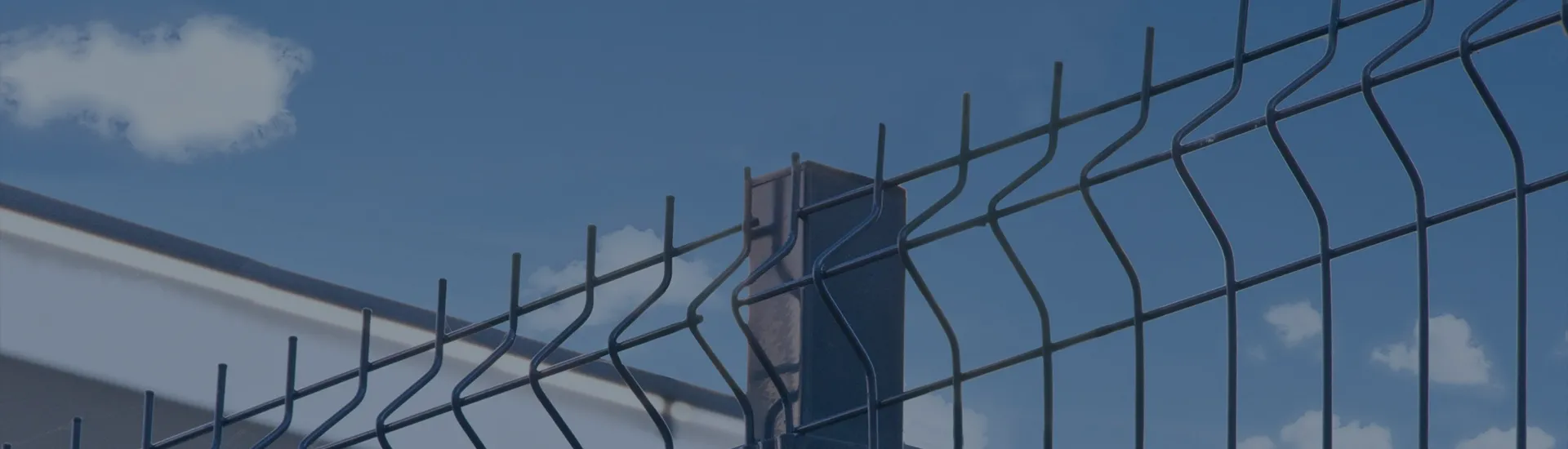
3D fence
3D fence
3D Fence


3D FENCE PANELS THAT HOLD THEIR SHAPE WITHOUT A FRAME
A 3D fence is a welded mesh panel with horizontal wires pressed into V-shaped folds. The folds are not decoration: they are what gives a panel only a few millimetres thick the stiffness to span between posts without a frame around it.
Hebei Jinbiao manufactures 3D panels with square or peach posts, in galvanised finish or with a PVC or powder coating in the colour the site calls for.
A flat welded panel of the same wire would flex and drum in wind. The bends convert that flat sheet into a folded plate, and a folded plate resists bending far better than a flat one — which is why a 3D panel can be fixed straight to the posts with clips and still feel solid.
HOW THE V BEND MAKES A THIN PANEL RIGID
The fold runs horizontally across the panel, and there are usually two or three of them depending on height. Each fold shortens the unsupported span of the vertical wires and turns the whole panel into a shallow beam.
That is the same trick used in car body panels and in profiled steel decking: geometry does the work that thickness would otherwise have to do.
The practical consequence is weight. A 3D panel gives boundary stiffness at a fraction of the mass of a framed panel, which matters for transport, for handling on site and for the post that has to carry it.
It also means the panel is not rigid in every direction — it resists bending across the folds well, and is comparatively flexible if pushed at a corner. Posts and clips are specified with that in mind.
BENEFITS OF HEBEI JINBIAO 3D SECURITY FENCE


The fold does the work of a frame, so the panel is lighter for the same rigidity. Lower weight means cheaper freight and easier installation.
The mesh is open enough to see through and dense enough to read as a barrier, which is what residential and commercial boundaries usually need.
Galvanised for a plain metal finish, or PVC and powder coated in a colour that sits with the buildings. Both are applied over galvanised wire, so a scratch does not become a rust point immediately.
Panels are fixed with clips or brackets, so one damaged panel is replaced without dismantling the run. On a long boundary that is the difference between a repair and a rebuild.
Single and double gates are made in the same section and finish as the panels, so the gateway does not look like an afterthought.
WHY HEBEI JINBIAO IS YOUR TRUSTED 3D FENCE MANUFACTURER
Hebei Jinbiao has been producing fencing and noise control systems for 30 years. Panels, posts and fittings are made in our own plant, so a non-standard panel height or a specific coating can be quoted without a subcontractor in the middle.
The company operates to ISO 9001 for quality, ISO 14001 for environmental management and ISO 45001 for occupational health and safety, and holds CE marking together with a factory inspection certificate and a traffic safety product certification.
Our export work includes boundary fencing and noise control systems supplied into rail, road and industrial projects in the Philippines, Indonesia, Thailand, Chile and Japan.
Outside China we manufacture and supply. Erection is carried out by the project contractor or the local installer, and we provide the drawings, the panel schedule and the fixing details they work from.


3D FENCE SOLUTIONS
The panel is the same; what changes is the post and the height, and those follow the site.
Residential boundaries — lower panels in a coated colour, square posts, matching gate.
Commercial and industrial perimeters — taller panels, galvanised finish, heavier posts.
Schools and sports grounds — greater height and a tighter aperture to keep a ball in.
Utility and substation compounds — panels combined with a topping where climbing is the concern.
Road and rail boundaries — long runs where the panel is fixed to a post line set by the alignment.
Where the requirement is anti-climb rather than general boundary, a 358 mesh panel with a small aperture is the correct product and is quoted instead.
3D FENCE WITH PEACH POST

The peach post is the rounded section used where the fence is seen from the street and the post is part of the appearance: a curved profile with the panel set into it, so the mesh meets the post without a visible bracket face.
It costs more than a square post and takes a little more care to set out, because the panel has to sit square in a curved profile. On a residential frontage that is usually worth it; on an industrial perimeter it usually is not.
Both post types take the same panel, so a run can change section at a gate or a corner without changing the mesh.
Featured Project Case Studies
Explore real-world examples of how our comprehensive services and solutions have delivered exceptional results in isolation and acoustic applications.

Mongolia Chicken Farm BRC Fence
In 2024 Hebei Jinbiao manufactured and supplied BRC double wire fencing for a 50,000-bird commercial poultry farm in Mongolia, where the perimeter has to keep foxes and wolves out and define the biosecurity boundary. The blue PVC coated panels are stiffened by V bends and carried on square posts, with the gate set as the single controlled entry.

Nauru Aiwo Port Terminal Upgrade Project Chain Link Fence and Double Swing Gate
The Aiwo Port Terminal Upgrade Project in Nauru required a durable perimeter fence and a controlled vehicle entrance for a coastal terminal. Hebei Jinbiao supplied a galvanized chain link fence together with a double swing gate, both finished to resist saltwater corrosion, so the terminal perimeter now runs continuously into the main gate.

Chain link fencing supplied for a Singapore rail corridor: 2.5 m hot-dip galvanised mesh, 50 x 50 mm, barbed wire on cranked posts for a tropical marine site.

Ghana Sports Court Welded Wire Mesh Fence Project
This Ghana sports court project features a black welded wire mesh perimeter fence around the playing area. The visible installation uses modular mesh panels and posts set on concrete bases, with higher fence sections positioned to help contain balls near the court.

In 2023 Hebei Jinbiao manufactured and supplied chain link perimeter fencing for a utility-scale photovoltaic plant in Peru: 2.4 m panels in PVC-coated galvanised wire, set on hot-dip galvanised posts for coastal desert service.

Galvanised temporary fence panels supplied for a Canadian infrastructure project: 2.1 m modular panels, interlocking feet and gates for a long-lifecycle site.


