


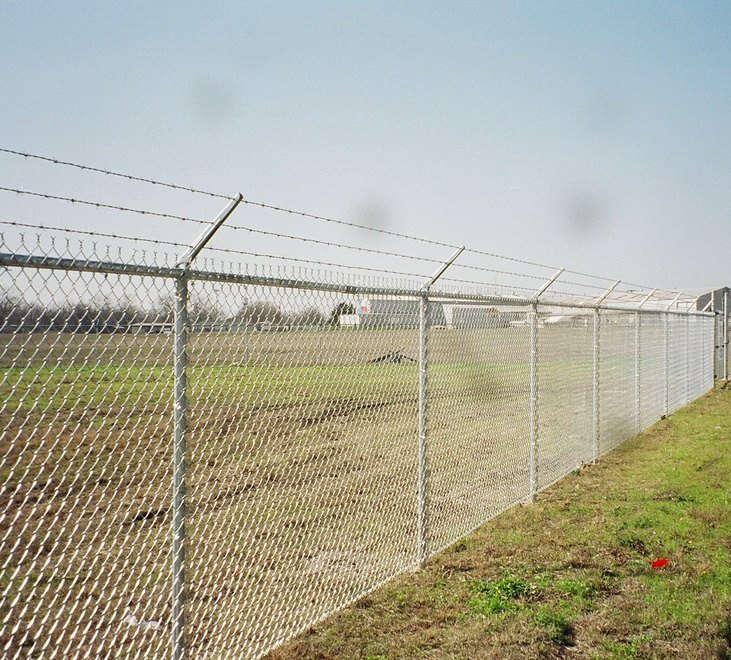


Our team works with you during every phase of the project.
Contact Us

hotproduct
Chain link fence is the cheapest way to enclose a large area, and the specification is decided by three numbers that most buyers never compare: wire diameter, mesh aperture and coating weight. Two quotes for the "same" fence can differ by half the price and both be correct for their own specification.
| Parameter | Common range | What it changes |
|---|---|---|
| Wire diameter | 2.5 mm to 4.0 mm | Strength and price per square metre; 2.5 mm is light garden work, 3.5–4.0 mm is site perimeter |
| Mesh aperture | 50 × 50 mm, 60 × 60 mm, larger for rough use | Smaller aperture resists cutting and climbing better and uses more wire |
| Coating | Galvanised, or galvanised plus PVC | Service life and appearance; PVC adds roughly 0.4–0.6 mm to the wire diameter |
If two quotes are far apart, ask for these three figures. Nine times out of ten the difference is a lighter wire or a thinner coating, not a cheaper supplier.
Galvanised is the default for agricultural, industrial and long-run perimeter work. The zinc coating is what determines how long the fence lasts, not the wire diameter — a 3.5 mm wire with a thin coating fails before a 3.0 mm wire with a heavy one.
PVC coated costs more per square metre and brings three things: colour, a second corrosion barrier, and a slightly thicker wire feel for the same core. It is the normal choice for parks, sports grounds, schools and anywhere the fence is in public view.
On coastal sites, specify the heavier coating rather than the thicker wire. The wire is rarely the limit; the coating is.
Chain link is a flexible fabric, so the frame is what makes it a fence:
Line posts at 2.5–3.0 m centres depending on height and wind exposure.
Top rail through the top of the fabric on most permanent installations — it holds the line and takes the load off the fabric.
Bottom tension wire as an alternative to a bottom rail, which stops the fabric lifting.
Strainers and braces at every corner, end and gate — the same principle as any tensioned fabric.
A chain link run without a top rail and without end bracing will sag and will not hold tension, no matter how heavy the wire is.
Heights run from about 1.0 m to 4.0 m. The practical logic:
1.0–1.2 m — garden boundary and demarcation; not a security fence.
1.8–2.0 m — standard site and sports perimeter. The most common height by a wide margin.
2.4–3.0 m — industrial perimeter, often with a topping.
Above 3.0 m — wind load and post section start to dominate the cost.
Gates are the part of a chain link contract that most often comes back. Three items decide whether they work: the opening width and clear height, the hinge side and swing, and whether the gate needs a dropped post or a wheel because of the ground.
The gate frame is heavier than the fence frame. A gate hung on a line post will pull it over within a season — gates need their own heavier posts with concrete foundations sized for the leaf weight.
Two installers using the same materials produce very different fences, and the difference is visible within a year.
| Detail | Done properly | Done cheaply |
|---|---|---|
| Line posts | Concrete foundation sized to height and wind; posts plumb | Driven posts, or shallow concrete |
| Fabric tension | Strained from a braced end post; fabric tight enough not to deflect under hand pressure | Pulled by hand between posts |
| Tie wires | At every 300–400 mm up each post, twisted and cut flush | Sparse ties, sharp ends left |
| Top rail | Continuous through the post caps, coupled at every joint | Omitted, or short lengths between posts |
| Bottom edge | Tension wire threaded and tied, or a bottom rail | Fabric left loose at ground level |
The bottom edge is the detail buyers notice least and regret most. A loose bottom edge lets the fabric lift, which opens a gap at ground level and makes the whole fence look neglected.
Chain link needs almost nothing if the coating was specified correctly, and a lot if it was not.
Annual check — walk the line looking for broken ties and slack fabric, particularly after wind.
Tension — a run that has gone slack can usually be re-strained from the end post without dismantling.
Coating failure — rust at the cut wire ends and at tie points is the first sign. Treating those spots early is what extends service life.
Vegetation — the practical enemy. A fence line kept clear lasts visibly longer than one buried in growth.
On coastal sites, expect the fixings and ties to fail before the fabric does. Stainless ties cost little more and are worth specifying up front.
Total run length, corners and ends.
Height.
Wire diameter and mesh aperture, if already specified.
Coating — galvanised, or PVC and which colour.
Gate schedule with widths and types.
Ground conditions and whether the line follows a slope.
For a boundary that only needs to mark an edge, 2.5 mm is adequate. For a site perimeter where the fence has to resist casual damage, 3.5 mm or heavier. Ask what the quote assumes — it is the single biggest driver of price difference between two chain link quotes.
It depends on the coating weight and the atmosphere, not on a fixed number of years. Inland dry sites last far longer than coastal sites with the same fence. Specify the coating for the site rather than accepting the default.
On permanent installations, usually yes — it keeps the line straight and takes load off the fabric. On temporary or very short runs, a tensioned top wire is sometimes used instead.
Yes, by racking the fabric to follow the gradient, or by stepping the panels. Racking is smoother and is the normal method for moderate slopes.
Where the fence is visible to the public, or where the site is coastal, yes. On an inland industrial perimeter that will never be looked at, the money is usually better spent on a heavier galvanised coating.
Send the run length, the height and the coating you need, and we will come back with a wire and aperture specification plus a price per square metre.
For the product range see chain link fencing, and for a specification example see chain link fence panels. For how the numbers translate into budget, see fence cost per metre.
Contact Us
Imfornation
Railway and HSR Noise Barriers: Design for Speed and Clearance29 STC Noise Barrier WholesaleSubstation and Transformer Noise Barriers: Controlling Low-Frequency Hum2m High Noise BarrierChain Link Fence: Wire, Mesh and Coating SelectionNoise barriers costMetal Noise Barrier Manufacturer358 Security Fence: Mesh, Wire and Anti-Climb SpecificationDouble Wire Fence: 868 and 656 Panels, Posts and FixingsSolar Noise Barrier Cost: What Drives the Price and the PaybackNoise Control Solutions1School Noise Barrier: Cutting Traffic Noise at the Classroom111Aluminum Alloy Noise Barrier Supplier3m High Noise BarrierGabion Baskets for saleResidential Noise Barrier: Height, Planning and AppearanceMetro Depot Noise Barrier: Enclosure for Depots and Over-Track DevelopmentConstruction Site Noise Barriers: Temporary Screens That Move With the Works6m High Noise BarrierNoise Barrier Guide: Types, Height, Cost and SelectionUrban Noise ControlIndustrial Noise Barrier SystemAnti-Climb Fence Specification: 358 Mesh, Paladin Pales and 3D PanelsCooling Tower Noise Barrier: Layout, Airflow and Panel Design3D Curved Fence Panel ManufacturersFence Cost Per Metre: What Actually Moves the Price of a Boundary Fence3D-Welded Mesh fencing systemTemporary Fence: Panels, Ballast and Wind Load on SiteInfrastructure Noise Control4 Meter Noise Barrier PanelHighway Noise Barrier Cost: What Drives the Price per Square MetreIndustrial Plant Noise Barrier: Boundary Wall and Equipment Enclosure5m High Noise BarrierConstruction Site Fencing: Temporary Panels, Welded Mesh or Hoarding0.85 NRC Noise Barrier WholesaleHospital Noise Barrier: Ward Targets, Height and CleanabilityGabion Basket Supplier