
Chain Link Fence
Chain Link Fence
PVC-Coated Chain Link Fence for Sports Grounds
PVC Coating and the Sports Ground Boundary
A sports ground fence is judged by two things that have nothing to do with appearance: whether the mesh stays flat after a season of balls hitting it, and whether the coating survives. Both come down to details settled before the panels are made — the wire core, the coating, the post section and the way the mesh is tensioned. This page sets out how those details are chosen, and what to send us so the quotation matches the ground.
Construction Details That Decide Service Life
Containment is geometry, not strength. The fence has to be tall enough for the trajectory the sport actually produces, and the mesh aperture has to be small enough that the ball cannot pass through it. A taller fence with the wrong aperture still lets balls out; a shorter fence with the right aperture keeps them in only below the height the ball reaches.
The height therefore follows the sport and the age group using the ground rather than a single standard figure. On a multi-use area the tallest requirement governs, because the fence is one continuous run.
On a sports ground the fence is hit constantly. Bare galvanised wire takes that impact and, over years, the zinc is worn away at the contact points, which is exactly where rust begins. The PVC layer absorbs the abrasion and keeps the galvanised core intact underneath.
The second reason is visibility. A dark green or black mesh reads as a boundary rather than a barrier, and it does not glare under floodlights, which matters on a court used at night.
Where the fence is taller than a normal boundary fence, the post section and the foundation have to grow with it. A tall panel on a short post pulls over in the first storm, and that failure is always traced back to the post, never to the mesh. Corner posts, end posts and gate posts carry higher loads than line posts and are specified on a heavier section.
Mesh that is not stretched properly sags between posts within a season, and once it sags it cannot be recovered by tightening the top rail. Tension bars run the full height of the panel, the mesh is stretched before the rail is finally clamped, and the load is taken into the rail rather than into the posts.
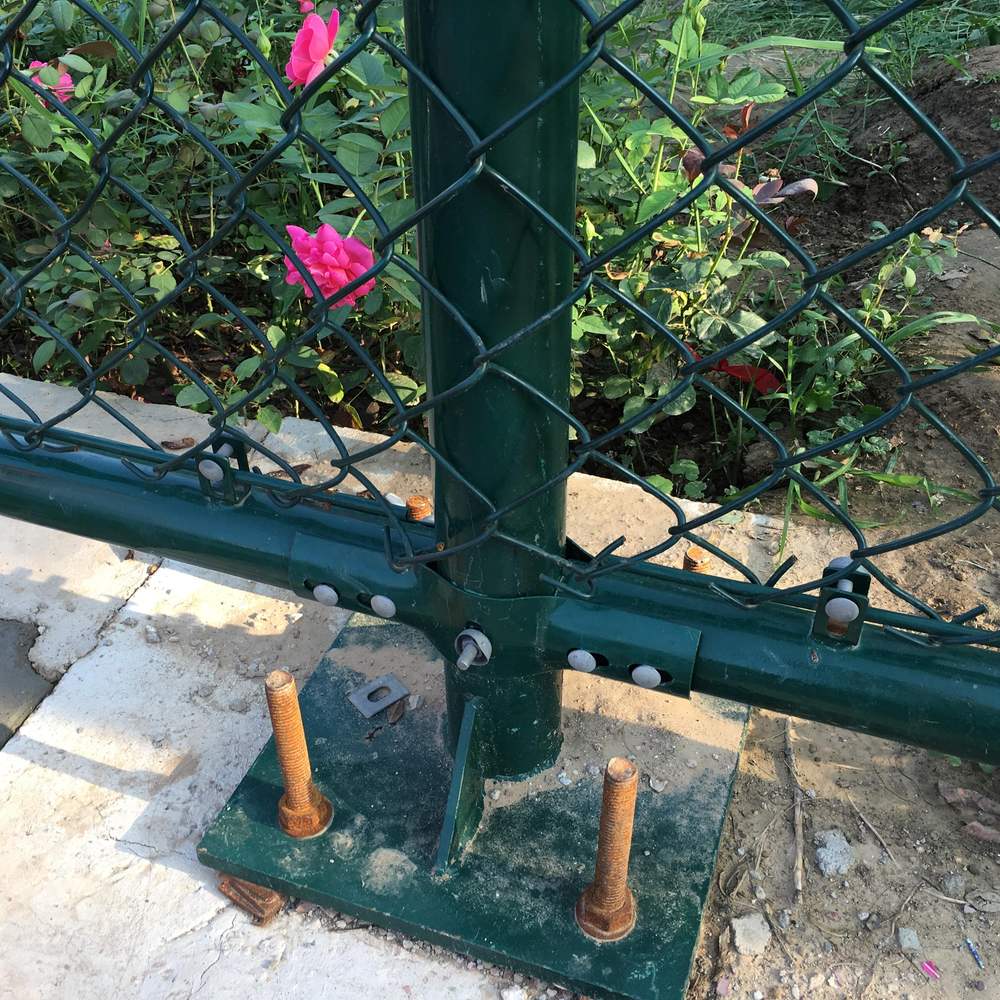
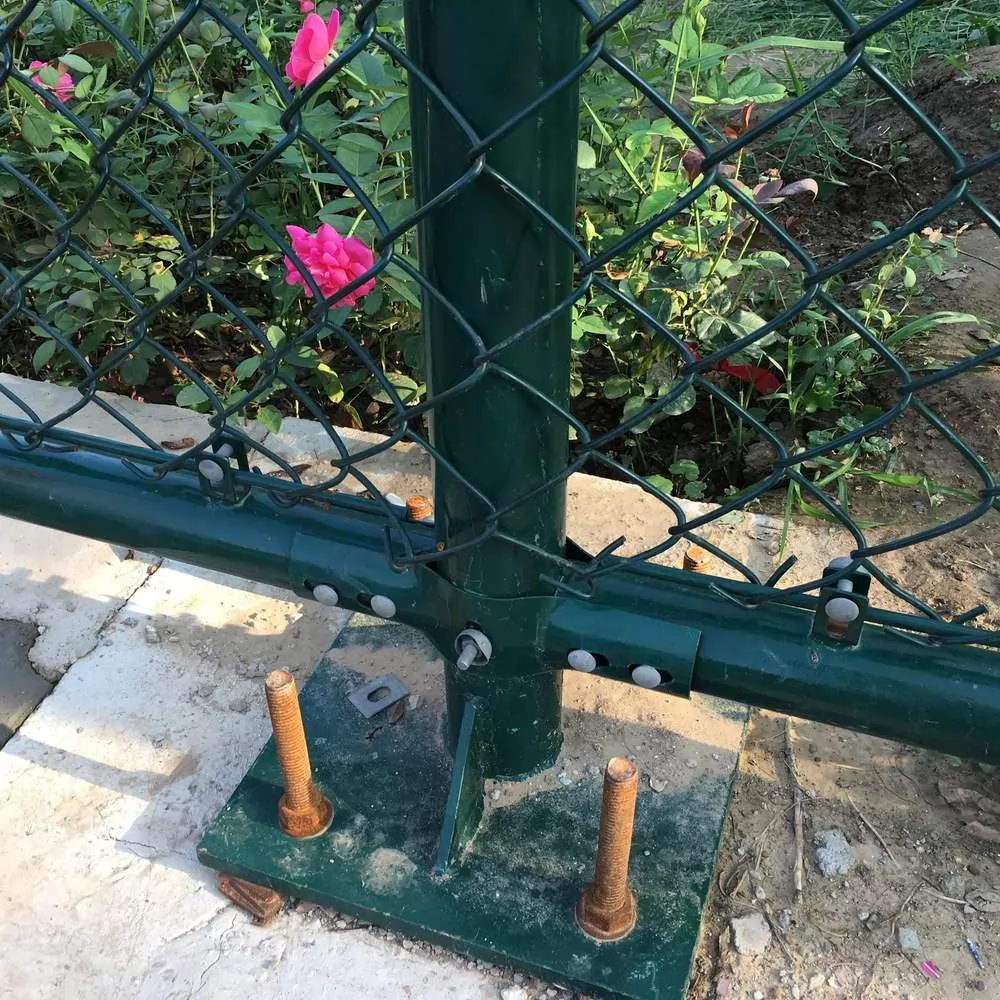
A bottom rail or tension wire keeps the mesh from lifting at ground level, which is where a ball most often escapes and where a lifted edge becomes a snagging point. The ground line also decides the foundation detail: a fence set on a kerb or slab is anchored differently from one set into open ground.
Gates are the part of a sports ground fence that fails first, because they are the only moving component and the only one used by hand. Gate width follows what has to pass through it, and gate posts are independent of the fence line so that gate load does not pull on the panels.

Coating and Where the Fence Is Used

Coating colour is usually chosen by the client or the club and rarely changes the price in a meaningful way. What matters is that the coating is applied over a properly prepared galvanised surface, and that cut ends and damaged areas are treated before the panels leave the works, because that is where a coated fence starts to fail.
Where the ground is coastal or the fence stands close to a chlorinated pool, the specification should say so at enquiry stage rather than at delivery, since the coating system and the fixing materials both change.
Football and multi-use games areas, where ball containment is the governing requirement
Tennis and racket courts, where the fence also carries the wind load of the surface
School and college grounds, where the fence doubles as a boundary
Training pitches and practice cages
Courts where a run of fencing divides two activities
What to Send for a Quotation
Sport and court dimensions, plus the height needed for containment
Colour, and whether gates are required and at what width
Ground conditions — kerb, slab or open ground — and whether the fence follows a boundary
Whether the client wants panels only or a complete supply with posts, rails and fittings
Destination port, so the packing and the freight basis are quoted correctly
Supply only outside China. Erection is by the client's contractor against our setting-out drawings.
Supply only outside China. Erection is by the client contractor against our setting-out drawings; we do not provide installation outside China.


Frequently Asked Questions
No. Strength comes from the galvanised wire core and the post section. The coating protects the core from abrasion and corrosion, which is what preserves that strength for the life of the fence.
Yes, provided the original post line and rail height are known. Extension is done at a post rather than mid-panel, and the added run needs its own end or corner post.
Not necessarily. Containment depends on the trajectory at the height of the fence, so a fence matched to the sport's real play height contains the ball without being built to an arbitrary maximum. Over-specifying height adds wind load and cost.
Base-plated posts on chemical or mechanical anchors, with plate and anchor size set by the post load. On open ground the posts are set in concrete footings instead.
Both. Panels are quicker to erect and easier to keep flat; rolls suit long runs and curved lines. The choice is normally made by whoever is installing.
Hinges, latch and any closers are supplied with the gate and specified against the gate leaf weight. A gate heavier than its hardware is the most common failure on a sports ground fence.
Colour is matched to the client's reference at enquiry stage. Send the reference with the enquiry rather than after the order is placed.
Yes. Drawings showing post positions, gate openings and foundation details are issued with the order so the client's contractor can set out the line.
Related: chain link fence panels and the fence cost per metre guide.
Components Supplied with the Panel

Chain link mesh in the aperture and wire diameter specified for the sport
Tension bar, tension band and top rail, sized to the panel height
Line, corner and end posts with caps, plus gate posts on a heavier section
Bottom rail or tension wire to hold the mesh at ground level
Gate leaf, frame, hinges and latch where a gate is specified


