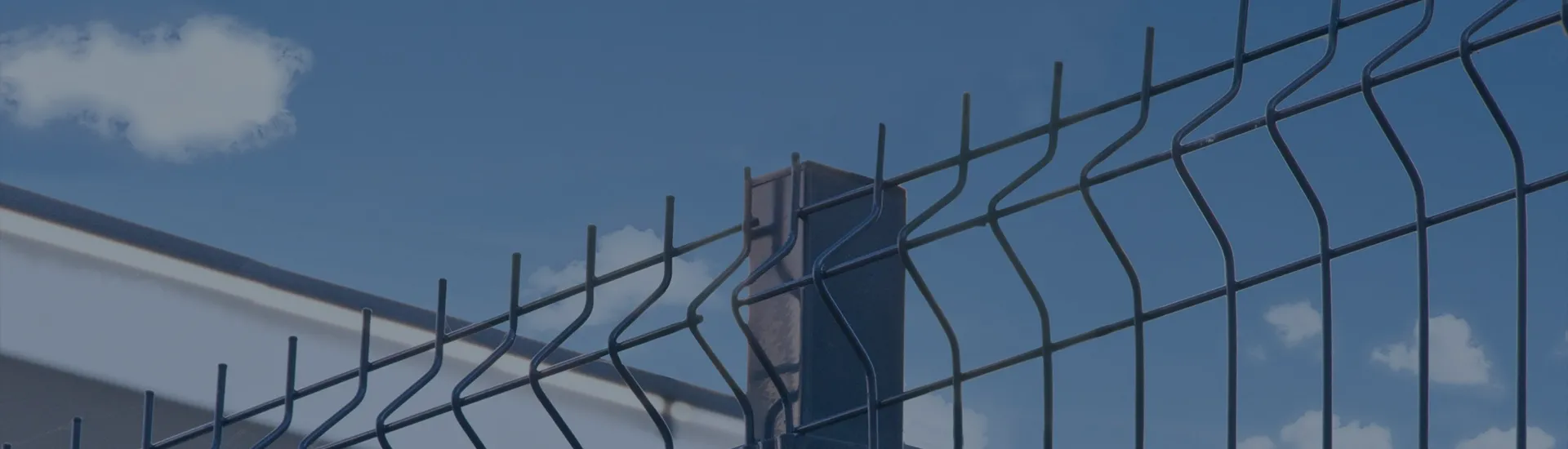
358 Security Fence
358 Security Fence
358 Anti-Climb Fence Panels with Barbed Wire Topping


Why a 358 Panel Carries a Topping Well
The mesh on a 358 panel is resistance welded at every intersection, so the panel behaves as a stiff plate rather than a loose sheet. That matters when a topping is added: the topping arm is bolted to the post and takes load sideways, and a rigid panel does not distort under that load the way a woven one would.
The second reason is the post section. A topped run is normally specified on a hollow section post heavy enough to carry the arm and the wire without leaning, because the topping adds wind area above the panel line rather than weight at the base.
The topping does not replace the panel. It closes the reach-over above the panel line, which is a different problem from the climb.
What the Topping Adds to Containment
A 358 aperture removes the handhold and the foothold: the horizontal opening is too narrow for a boot, and the vertical opening is too small for fingers to curl through. What it does not remove is the reach over the top edge.
A topping answers that. Barbed wire or a spike strip sits on arms above the panel, so a person who reaches over the top meets the wire before reaching the far side. The topping is specified against the threat at that site, not as a default on every run.
Where the client's specification or the local rules do not allow a topping, the same containment is usually achieved with a taller panel instead. Both are legitimate; they solve the same problem in different ways.
Topping arms, wire and tensioning are quoted as a separate line so the client can see what the topping adds to the run.

Fixing the Topping to the Post

The topping is carried by the post, never by the panel. Arms bolt through the post section at a spacing set by the wire type: a spiral wire needs support often enough that it cannot be pushed down, and a straight wire needs enough tension points to stay taut in wind.
Every junction is a corrosion point. Arms, bolts and the top of the post are where a topped run fails first, so the finish on those parts matters as much as the finish on the panel. Galvanised is the baseline; a powder coat over it is a colour and a second barrier, not a replacement for the zinc.
Post caps are fitted after the arms, so water does not enter the post section and start corrosion from the inside.
Where Topped Runs Are Specified
A topping is usually specified where the boundary is long, the site is unattended at night, and a taller panel would either cost more or be seen as out of scale with the surroundings.
Long industrial and utility boundaries
Sites unattended overnight
Runs where a taller panel would be out of scale
Compounds holding plant, fuel or materials


What to Send for a Quotation
Send the run length and height, the number and width of any gates, whether a topping is required and which type, the post fixing (concrete footing or base plate on a slab), and the destination port so packing and freight basis are quoted correctly.
Supply only outside China. Erection is carried out by the client's contractor against our setting-out drawings; we do not provide installation outside China.
Components Supplied as One Set

Panels, posts, full-height clips or security bolts, post caps and topping arms travel as one consignment, marked against the panel they belong to. Gate leaves are packed separately with their hinges and latch, matched to the leaf weight.
Folded panel edges are standard: they stiffen the panel and remove the exposed wire ends that snag clothing and hands.


